|
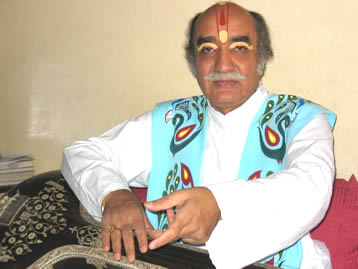
Dr Pandit Gokulotsavji from Indore Gharana is the son of the late Gridharlalji Maharaj, himself a knowledgeable musician.
Indeed, by the time Gokulotsavji was old enough to embark upon his own journey into Hindustani classical music,
he was well aware that he was following a path well-trodden by his ancestors.
In his youth, Gokulotsavji was tutored by Pandit Moreshwar Rao Golvelkar, a talented practitioner of the Gwalior and Kirana schools of music. Gokulotsavji’s guru ingrained in him a sense of dedication which soon began to stir in him a thirst to explore higher and nobler realms of music. It was under his tutorage that Gokulotsavji learnt many compositions by latter-day masters.
Dr Pandit Gokulotsavji grew up listening to recordings of old masters like Ustad Aman Ali Khan, Bhindi Bazarwale,
Ustad Abdul Wahid Khan and particularly Ustad Amir Khan,
the great maestro who inspired him to develop serenity and vigour in his performance.
In fact for some time, his performance emulated the work of the titan.
Gokulutsavji soon evolved though, modifying his style to suit his own compositions.
Many other classical musicians derive inspiration from his singing as he is regarded as the
leading practitioner of Drupad gayaki and Kirtan pad gan .
His taan patterns and elaboration of raga are totally unique and unknown to any gharana.
Gokulotsavji is an unrivalled contemporary composer and musicologist.
His knowledge of scripture is also reflected in his books written on music such as “Vitthalesh Keertan Ratnakar” (in 2 volumes) which contains the compositions and gayakis of drupad-dhamar style. The combination of his intellect and meditation has produced unique musical compositions which continue to enthral and captivate audiences.
Under the pen name of Madhur Piya, he has published some 5,000 compositions in Khyal Dhrupad and other allied genres, in Sanskrit, Persian, Urdu and Braj Bhasha.
He has also created several Ragas.
Gokulotsavji's mellifluous voice covers an amazing three octaves.
Its range and flexibility is complimented by an evenness of tone, a supple bass register,
a strong medium and a bright agile top.
He has amazing breath control and a seasoned stage presence
which is derived out of a sur-minded and cerebral gayaki.
His music touches a range of emotions.
He dwells on each note in a leisurely fashion and weaves interesting patterns around them,
rendering his recital unique.
His introspective intricate taans go to fire his own fertile imagination.
His introspective Gayaki (of which his use of sargam sequences is the highlight) puts him in a class of his own.
Gokulotsavji's music does not suffer from mechanical precision.
Rather, it has a deep instinctive quality.
His Rubaider Tarana (introduction of Persian couplets into Tarana) is meaningful and enjoyable.
He has acquired the Late Ustad Amir Khan's technical finesse and skilful exposition of intricate taan patterns.
To this he has applied his own imaginative skills and expertise, which is what makes his recitals so extraordinary.
Gokulotsavji’s approach to Indian classical music has a human aspect;
he believes that music should be from the heart,
its function is to reveal the joy and pathos of life.
He believes also that the singer must be able to create a rapport with the audience,
for it is only through notes and shruties that the musician can create and communicate
the world of his own imagination.
|